
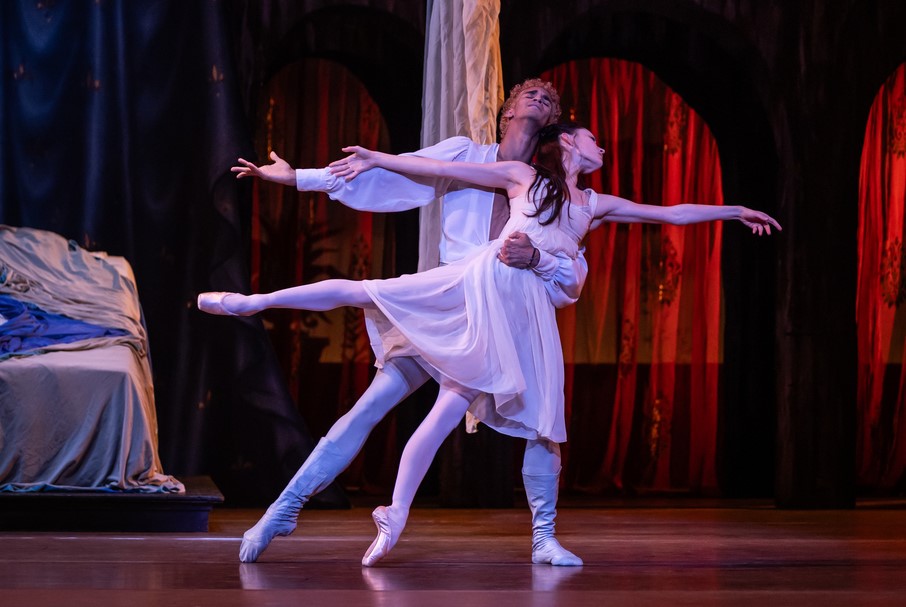
Grace Carroll as Juliet and Davi Ramos as Romeo in The Australian Ballet’s Romeo and Juliet.
Image credit: David Kelly

One of William Shakespeare’s most tragic love stories is brought vividly to life in The Australian Ballet’s exquisite production of John Cranko’s ballet Romeo and Juliet.
Ballet presents a unique challenge in translating some of Shakespeare’s most profound spoken texts into an unspoken art form, where dance and expression take centre stage to convey exposition without the crutch of spoken dialogue. Thus goes the old saying: ‘it’s better to show, not tell’, trusting the audience not only to comprehend the narrative presented before them but to uncover a sea of new meaning from such a beloved tale. The opening of this incredible production displays this translative artistry, as the hopeless romantic Romeo reveals himself to his love Rosaline – an incredibly short-lived romance, as the title rather gives away: it is, after all, Romeo and Juliet, not Rosaline. Romeo gazes across the moonlit town square to see his love Rosaline standing on the walkway above, sweeping over to her as she drops a fan down to him before departing – a gentle nod to the historic flirtation device of a lady dropping a handkerchief to invite romantic pursuit. This is the first of many references to distance between lovers we see in this iconic portrayal.
Brisbane audiences were treated to exquisite performances from Brett Chynoweth and Yuumi Yamada as the star-crossed lovers on Monday night. Chynoweth brings a youthful exuberance and softness to Romeo, and it is immediately apparent from the moment he locks eyes with Juliet across the ballroom that the young Montague is completely enamoured with her, their infatuation with Rosaline seemingly forgotten in an instant. Chynoweth truly is an A+ yearner as Romeo, offering wistful stares into the distance whenever he is parted from Juliet. It is a thoroughly swoon-worthy performance. Yamada brings a delicate and playful energy to Juliet; from her antics with Nurse to her flirtatious exchanges with Romeo at the Capulet ball, the audience is in no doubt that this is a very young woman experiencing the exhilaration of first love. After all, in Shakespeare’s original text, Juliet is a mere thirteen years old to Romeo’s seventeen.
The beginning of the ballet leaves the audience in no doubt of the looming darkness that hangs over this story, with the ongoing feud between the Capulet and Montague families brought to life through an opening fight scene of tightly choreographed fencing. Whilst the dancers may be silent, every beat and turn of the swords moves in perfect synchrony with Sergei Prokofiev’s sweeping score, performed live by Queensland Symphony Orchestra under the baton of Jonathan Lo. If there is anything audiences are sure to recognise from this ballet, it is the music, particularly as the Montagues and Capulets enter the Capulet ball. Often referred to as the ‘Dance of the Knights’, it has become one of the most iconic compositions in music, regularly appearing across film and TV. Its sharp and sinister sound immediately communicates that no one is truly at ease, with the feud threatening to erupt at any moment.
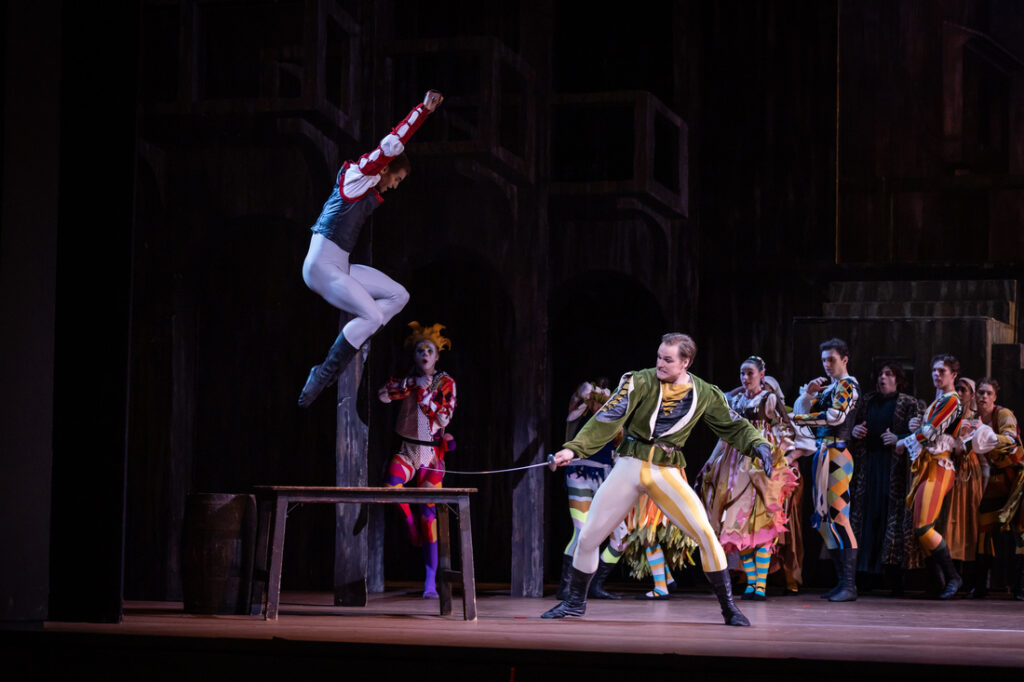
Image credit: David Kelly
Set and costume design by Jürgen Rose further reinforces the contrasting identities and tensions between the characters. Dark set pieces provide a striking contrast to the bright colours worn by Romeo, Juliet and the townspeople, while the Capulets and Montagues are dressed in darker hues to convey the brewing war and hatred between the two families. Interestingly, across many adaptations, the Capulets are traditionally depicted in red and the Montagues in blue to signify their opposing identities. In this production, however, the Montagues adopt red as their signature colour, while the Capulets are represented through a mixture of blue and yellow tones. Yellow is arguably the predominant colour of Juliet’s wardrobe from her first appearance on stage, yet upon entering the Capulet ball she wears a white dress with a red ribbon sash, bearing a striking resemblance to Maria’s party dress in West Side Story. It is not until later, when Juliet marries Romeo, that her costume changes to orange, symbolising the union of the red and blue associated with their opposing families.
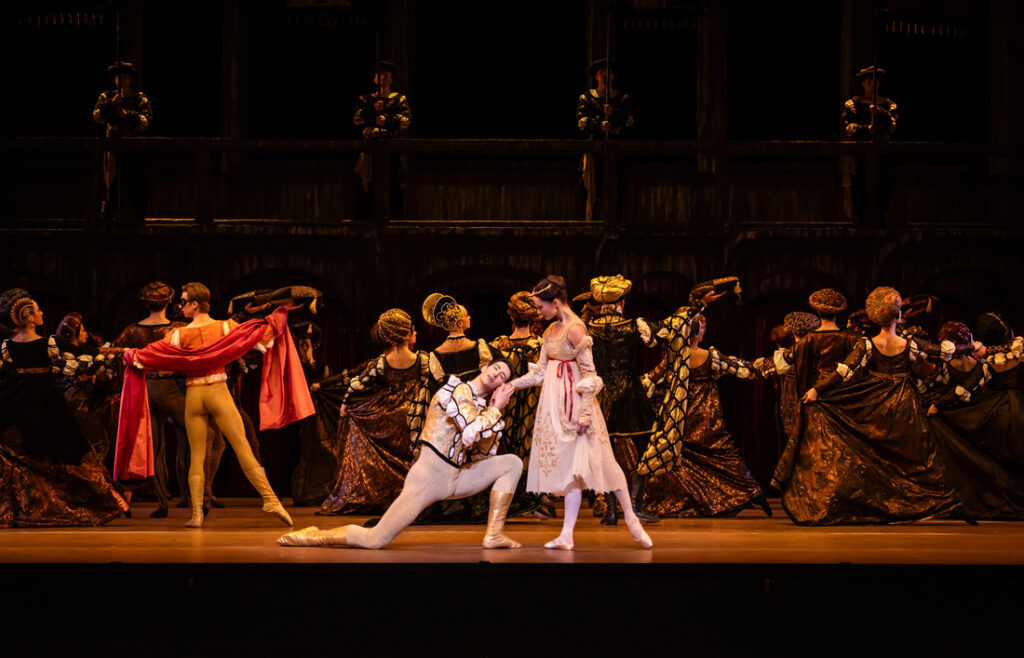
Image credit: David Kelly
True artistry was on display at the Capulet ball. As Romeo pursues Juliet for a dance while she is kept occupied by her suitor Paris, a delightful moment of flirtation unfolds between the two. As Romeo approaches Juliet, she briskly retreats in a bourrée en arrière, Yamada moving with such fluidity that she appears to float across the stage. As we gradually reach the conclusion of act one, the audience is transported from the confines of the ballroom to the rich evening landscape of the balcony scene, arguably one of the most romantic pas de deux audiences could hope to see. From incredible overhead lifts to en pointe kisses (literally), it is a breathtaking spectacle that leaves you starry-eyed and floating on cloud nine. The balcony pas de deux is a true standout of the ballet and the perfect high on which to leave audiences as they enter the first interval.
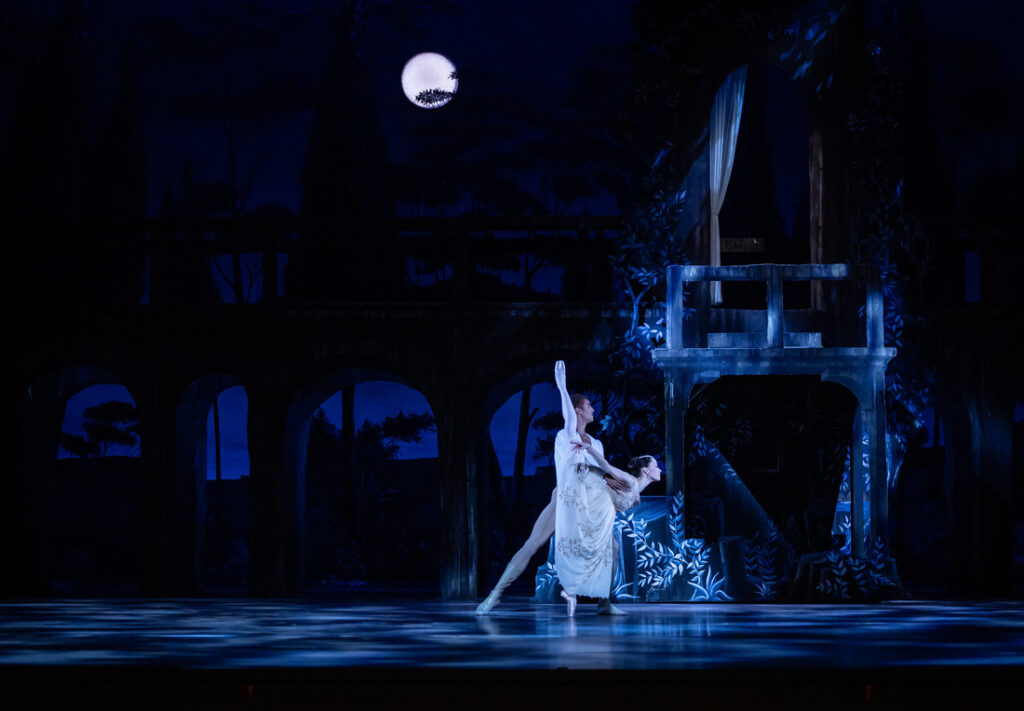
Image credit: David Kelly
Interesting moments that capture the eye throughout this production include our introduction to Friar Laurence, the mediator in Romeo and Juliet’s marriage who, incidentally, also plays a role in their deaths. He is seen holding a skull in one hand and red flowers in the other, imagery that could symbolise the fleeting nature of life and foreshadow the tragic fate that awaits the young lovers.
What I love about Romeo and Juliet as a ballet is its willingness to explore the whimsical, playful nature of the characters we meet through dance and play, particularly Romeo’s best friend, Mercutio. His fun and flirtatious energy, portrayed by Marko Juusela, provides moments of lightness amidst the growing rivalry between the opposing families. Perhaps what makes Mercutio’s death so tragic is his determination to remain true to his gregarious nature even in the face of death. From kissing girls for good luck to swigging back goblets of beer, his drawn-out death becomes a final display of the indomitable nature of his character, particularly in contrast with his love-stricken friend, whose world has become consumed by his love for Juliet.
Parallel to this is Tybalt’s death, which is quite possibly one of the most impactful death scenes of the ballet. Lady Capulet is seen tearing at her dress upon discovering his lifeless body, a historical expression of grief with biblical precedent in the accounts of Jacob, Job and King David. It is an incredibly raw and visual representation of grief, making her reaction later in the ballet all the more striking. When Juliet is believed to be dead after taking the sleeping potion, Lady Capulet instead sits over her daughter, gently holding her in a state of quiet anguish. The contrast between these two expressions of maternal grief is particularly powerful: where Tybalt’s death provokes an immediate, visceral physical response, Juliet’s apparent death is met with a subdued stillness.
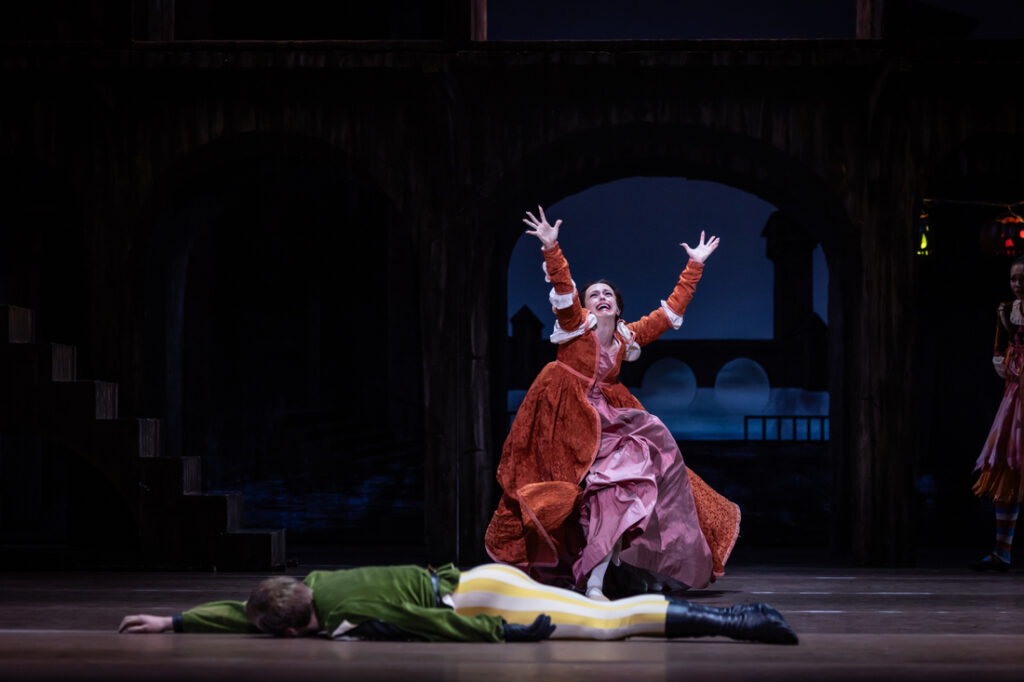
Image credit: David Kelly
One of the many clever ways in which Shakespeare’s text is communicated throughout the choreography can be seen in act three, scene one of ‘Juliet’s Bedroom’. In Shakespeare’s play the line reads;
“Wilt thou be gone? It is not yet near day: It was the nightingale, and not the lark, that pierced the fearful hollow of thine ear; Nightly she sings in yon pomegranate-tree: Believe me, love, it was the nightingale.” (Juliet, Act 3, Scene 5)
The balletic translation of this dialogue sees Romeo rise from bed and open the curtains to reveal the morning sun, before Juliet hurriedly closes them again, physically embodying the lovers’ conflicting perceptions of whether night has ended.
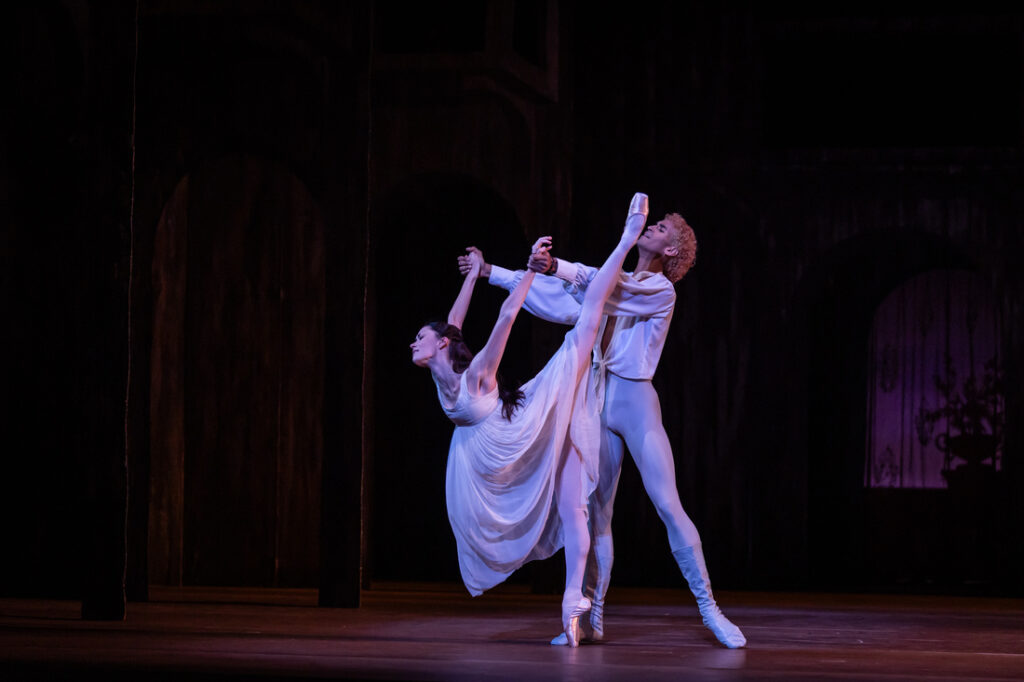
Image credit: David Kelly
Each sweeping moment and embrace in the choreography of the ‘Juliet’s Bedroom’ pas de deux reveals Romeo’s desire to imprint each moment he shares with Juliet into his memory. He cradles her face in his hands before moving away and holding his hands up before him, as though trying to preserve the memory of her face. As Juliet repeatedly falls into Romeo’s arms throughout each step and turn, Romeo appears to disappear behind her, creating the impression of a ghost carrying Juliet. This offers another clever echo of Juliet’s premonition before Romeo departs: “Methinks I see thee, now thou art below, as one dead in the bottom of a tomb,” foreshadowing the tragic end that lies in store for the lovers. Further to this, the musical theme accompanying Romeo and Juliet’s dance sequences together perfectly encapsulates the hope of the young lovers, while its melancholic undertones subtly reveal to the audience that their story is not going to end well.
The burial of Juliet is a visually stunning moment in the ballet from a design perspective. The first time we see Juliet on the balcony, she is met by Romeo beneath the moon; this time, she is brought in by a funeral procession on an open casket and placed at the centre of the balcony walkway above, before being lowered down into the Capulets’ family crypt. The visual transformation of the balcony, from a place of romance and possibility to the site of Juliet’s burial, makes for an incredibly striking and moving image.
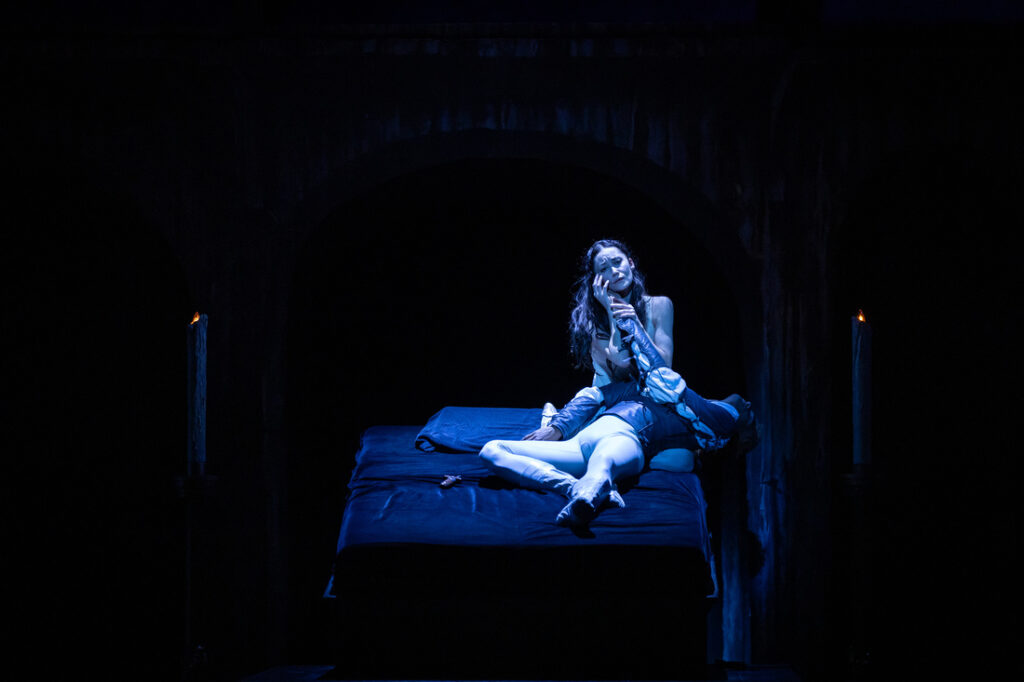
Image credit: David Kelly
Possibly one of the most ingenious and subtle choreographic choices in the ballet is the structural echo of Romeo caressing Juliet’s hair as she lies in his arms. A gesture first seen in ‘Juliet’s Bedroom’ scene returns in the ballet’s final moments, when Romeo discovers what he believes to be Juliet’s lifeless body in the Capulet’s Crypt. His last act before taking his final breath is to caress Juliet’s hair as she lies beside him, transforming what was once an intimate gesture of love into one of profound grief. The symmetry is deeply poetic: the first and last moments of Romeo’s day are marked by the same gesture towards the woman he loves. Juliet creates a similar structural echo, holding Romeo’s hand to her face in both scenes before taking her final breath.
The Australian Ballet’s Romeo and Juliet is romance personified, beautifully capturing the essence of this enduring tale of love and woe that continues to enchant audiences far and wide. The story of Romeo and Juliet can often lead audiences to view their initial meeting as lust at first sight rather than love, making it difficult to invest emotionally in such a doomed romance. It is therefore a true testament to the performances of the dancers that you cannot help but hope, just for a moment, that perhaps this time the young lovers might escape their fate and see true love conquer all. This production gives you that desperate hope for a happier ending and is worthy of every star in the night sky for making you believe in it.
Romeo and Juliet takes its final bow in Brisbane on Saturday 22 August. Parting is such sweet sorrow – book now at qpac.com.au before the curtain falls.