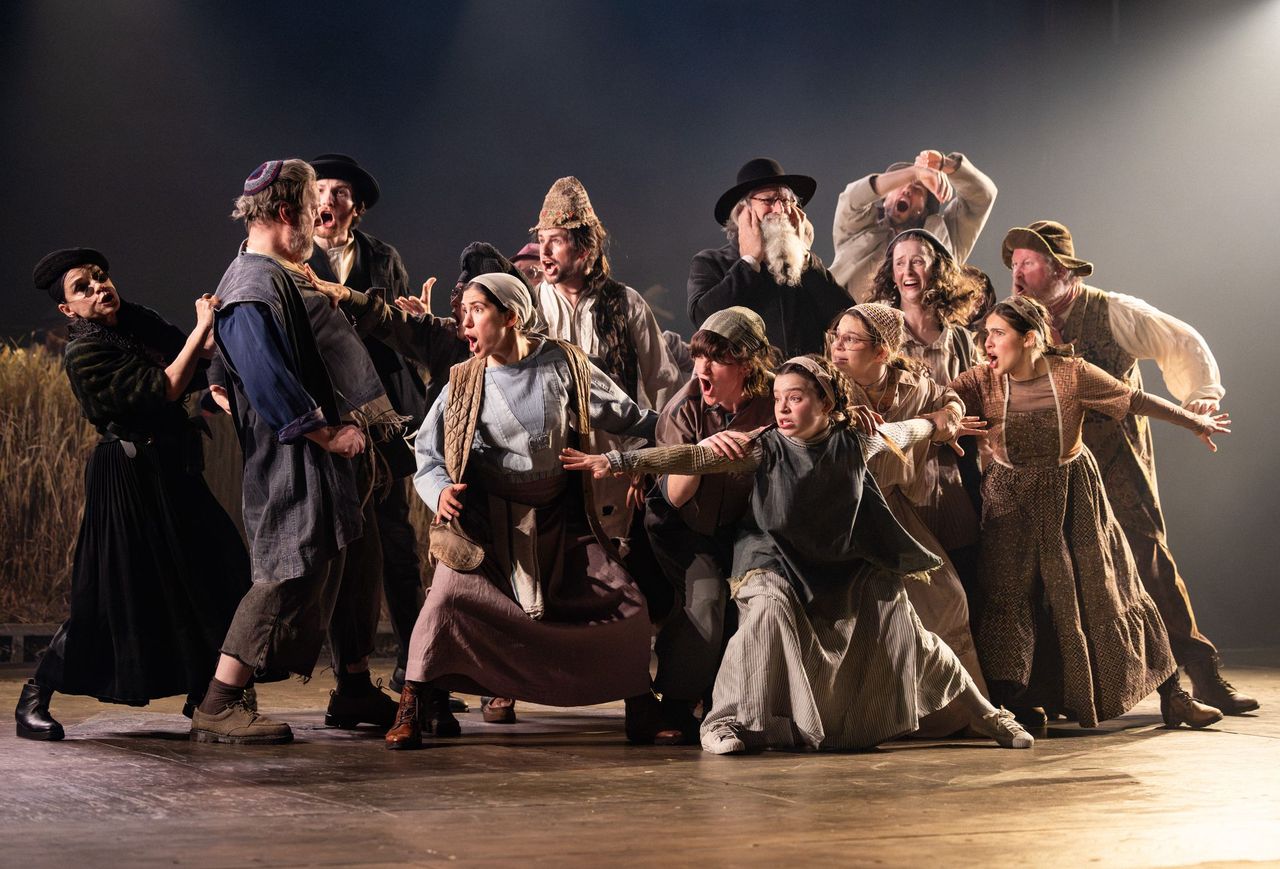
The Ensemble of Fiddler on the Roof. Image credit: Daniel Boud.

It’s a miracle! This October, Brisbane audiences are being treated to the brand-new West End transfer revival production of Fiddler on the Roof.
Many of us who love theatre can recall the first show that made a profound difference in our lives, and if we’re lucky, it becomes the defining moment that pushes us into pursuing a career within this weird and wonderful industry. Having been exposed to many excellent musicals growing up, I can earnestly say that Fiddler on the Roof was one such show that impacted my desire to work in the performing arts. From watching my older brother play the Rabbi’s Son in a local theatre production to seeing Chaim Topol perform the lead role 21 years ago at QPAC’s Lyric Theatre, a role he made so iconic in the 1971 film, I had no hesitation in booking a trip to see this outstanding musical. Seeing it again in 2026 has rekindled my deep appreciation for the beauty that surrounds the story, its characters and music.
Set in the early 1900s, we meet milkman Tevye, played by Troy Sussman (Back to the Future, Sunset Boulevard), who lives in the little town of Anatevka with his wife Golde, played by Alexis Fishman (Anne Being Frank, Kiss of the Spiderwoman), and their five daughters. With the eldest daughter Tzeitel, played by Freya Boltman (Spring Awakening, Heathers), bound for marriage, the second and third daughters Hodel, played by Ellen Ebbs (Head Over Heels, Pinocchio), and Chava, played by Caity Plummer (Sunset Boulevard, The Pyjama Game), remain cautiously optimistic of their own matches yet to be decided by Yente the matchmaker, played by Sigrid Thornton (SeaChange, A Streetcar Named Desire). With well-known classics as ‘Tradition”, “If I Were a Rich Man”, “Matchmaker, Matchmaker”, and “Sunrise, Sunset”, I would be shocked if the average Fiddler on the Roof novice didn’t recognise these classic tunes so often quoted across pop culture and media.
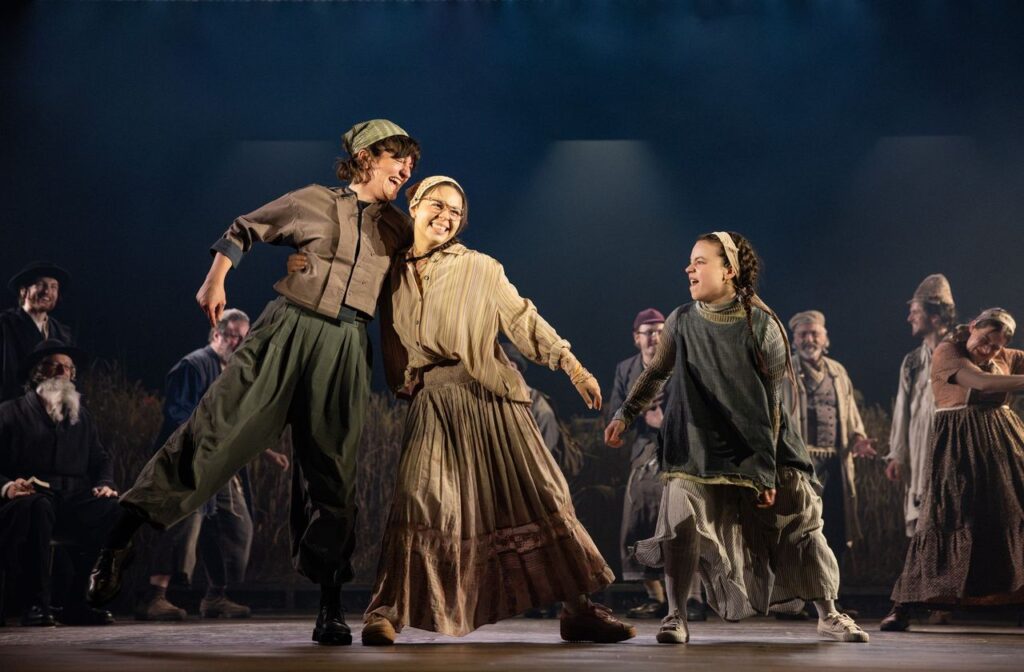
Whilst simple in its set design, this revival production direct from the West End grabs you from those first few iconic notes, as we enter the opening number “Tradition”. In fact, it took me halfway through this song to realise the band was on stage! The choreography of this production is impeccable, no performer missing a beat. And as audiences will discover over the course of the story, tradition is the driving force behind Tevye’s decision-making as a husband and father, inherently tied to his identity and faith as a Jewish man. In Tevye’s opening speech he says, “Here in our little town of Anatevka, you might say every one of us is a fiddler on the roof trying to scratch out a pleasant, simple tune without breaking his neck”. This production really makes you feel the weight of this analogy as Tevye is forced to reckon with the tenacity of his daughters’ fight against the peace and order found in the tradition of their faith, favouring their own choice of match, in turn combating his own beliefs in a constantly evolving world.
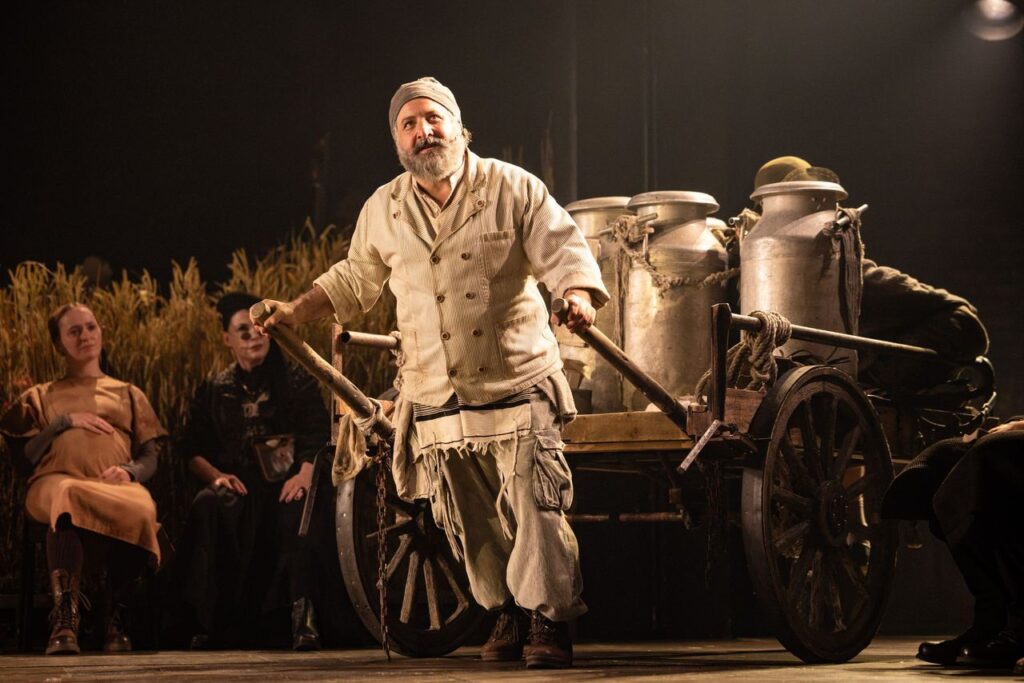
It is rare to find a musical that captures the beauty and struggles of a life lived out in faith, and despite Tevye’s battle against worldly desires of fame and fortune, he remains humble in the gifts God has given him, relying on God’s wisdom through devout prayer. “If I Were a Rich Man” is deeply reflective of this. Troy Sussman plays an excellent Tevye, however, I do feel this number could have been met with more gusto to really emphasise the character’s internal struggle at this point in the story. The line, “Lord, who made the lion and the lamb, You decreed I should be what I am, Would it spoil some vast eternal plan, If I were a wealthy man?” should be a true cry out from the soul, which instead felt subdued by the lack of strong music backing.
Moments that really capture the beauty of faith in community is “Sabbath Prayer”, which portrays each family in Anatevka holding the sabbath meal and praying over their children. As Tevye and Golde pray over their daughters for strength and protection, “May you be like Ruth and like Esther, may you be deserving of praise…”, one by one, members of their community begin laying hands on the daughters to pray over them, a beautifully poetic display of prayer over their futures in a time of uncertainty.
What works so well with the pacing of this production is the way its high energy musical numbers complement the moments of stillness and reflection. One number that often feels out of place with the rest of the music but always works remarkably well is “Tevye’s Dream”, when he must convince his wife Golde that Tzeitel should marry her childhood sweetheart Motel the Tailor, played by Felix Star (Macbeth, Chitty Chitty Bang Bang), instead of Lazar Wolf the Butcher, played by John Waters (Waitress, The Woman in Black). This was done extremely well and really leans into the absurdity of Tevye’s made up conversation with Golde’s grandmother Tzeitel. The ghost of Sarah, Lazar Wolf’s late wife, is often portrayed in stage and film as flying through the air – however, I love this production’s take! Instead, with bed sheets turning into long puppet-like arms coming to attack Tevye, later reappearing with a bloody butcher’s apron and knife, creating a moment of dark humour in the show.
The end of Tzeitel and Motel’s wedding is always a shocking scene to witness and seeing it again 21 years later does not make it any less difficult watch. The room was completely silent with intermittent gasps – it’s a heavy scene to take in before entering the interval but important in helping the audience understand the reality of the world the characters are living in.
The cast of this production is excellent, and it is clear from the strong ensemble work that there is much joy had in performing this musical eight times a week. However, one element that admittedly felt a little jarring at first but is certainly not a deterrent to enjoying the show, is the decision to have performers speak in their own Australian accents. The film and previous stage adaptations have used American accents with a Russian inflection, and perhaps it is that I’m more used to the American accent in musical theatre, but the Australian accent does feel like a jump scare for characters living in a small town in Russia.
Whilst there is much to celebrate with weddings and matches, there is a continual underlying sadness that comes with pulling away from the fabric of tradition. Each of Tevye’s eldest three daughters marry men who are not of their father’s choosing, with Chava choosing the most unforgiving match in Tevye’s eyes, a man outside of the Jewish faith. His resolve to disown his daughter due to perceived betrayal is not an unfamiliar experience that many people continue to experience across different cultures today. Caity Plummer plays the clarinet during “Chavaleh” – this is an incredibly smart artistic choice as we see Chava at the play’s conclusion swapping places with the fiddler, now herself on the roof, makes for a full circle moment when we consider Tevye’s opening statement. It feels very symbolic of her decision to break with tradition creating a new path for herself and hence a different tune to her family.
Fiddler on the Roof is a unique musical that remains relevant in its messaging 60 years later. Staying true to the source material, whilst providing a fresh take on the melancholic tale, this is a heartbreakingly beautiful revival not to be missed.
Fiddler on the Roof is now playing at QPAC’s Glasshouse Theatre until 25 October, before making its way to Melbourne and Perth. Book now at qpac.com.au