
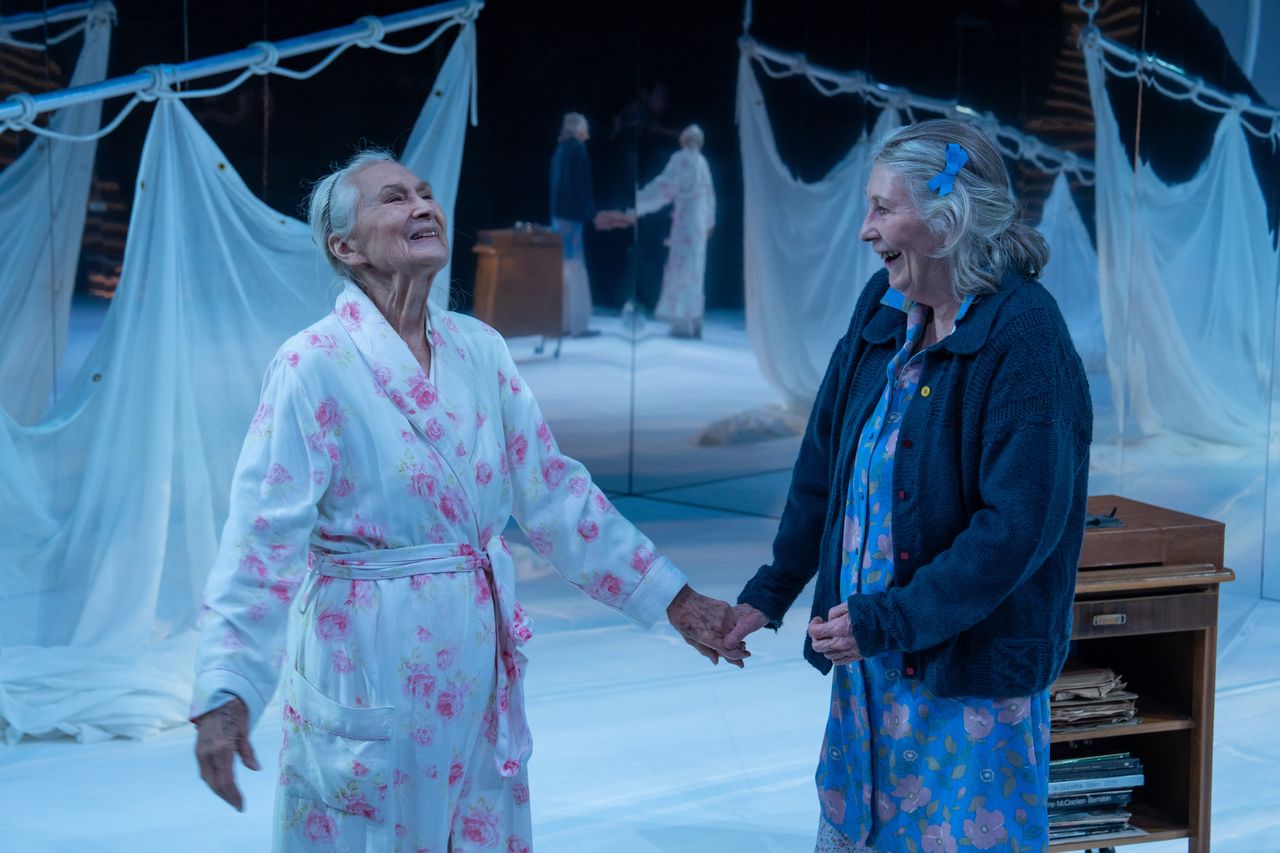
Marilyn Richardson as Maria and Jennifer Flowers as Mary in Queensland Theatre Company’s Do Not Go Gentle. Image credit: Stephen Henry

Queensland Theatre Company confronts the harsh reality of life with dementia in Patricia Cornelius’ Do Not Go Gentle.
Dementia is a cruel condition that impacts the lives of so many people. In Patricia Cornelius’ Do Not Go Gentle, we get a confronting insight into the varied ways it can impact a person’s perception of reality as memories begin to fade. Many of us will be forced to reckon with this at some point in our lives, whether as the grandchildren or children of someone living with dementia, or perhaps experiencing it ourselves in old age. This production does well to demonstrate how dementia can impact people in vastly different ways, culminating in one key plot twist near the play’s conclusion, which I shall not be revealing!
To help give us, the audience, an avenue to grapple with what this reality looks like for the characters we meet in this play, the story traverses an adventure that mirrors Captain Robert Falcon Scott’s unsuccessful journey to discover the South Pole in 1911. What the travelling group believes is a journey into the unknown, each filled with their own sense of purpose, never actually takes them beyond the nursing home exit. Instead, each character is visited by ghosts of their past and present, serving as painful reminders of their distorted understanding of time and place. One of the more heart-wrenching discoveries is the youngest explorer, Claudia, played by Christen O’Leary (Round the Twist: The Musical, Ladies in Black). Considerably younger than her comrades in arms, Wilson/Mary reminds her, “You’re too young to be here.” Once a journalist, wife and mother, Claudia is now stuck in the painful confusion of not even knowing who she is, let alone remembering the life she once lived.
One of the most delightful performances in this production comes from Jennifer Flowers (Arcadia, Private Lives) who plays Wilson/Mary. Her character’s persistent optimism and consideration for the feelings of others are beautifully displayed in a sweet moment with Maria, played by Marilyn Richardson (Aida, La Traviata) as they reflect on love lived and lost in slow dance to music. Mary knows she has lived what she believes to be a fulfilled life but cannot recall what she has done beyond having a family. Despite her character’s failing memory, Flowers allows Mary’s compassion for those around her to shine through, painting a fuller picture of who she is beyond her life as a housewife.
A particularly poignant moment comes through the character Oates/Titus, played by stage and screen veteran Bruce Spence (The Lord of the Rings, Mad Max 2: The Road Warrior), when he is given the opportunity to step back into a memory of playing with his son during his youth, before being transported forward to the unravelling of their once-close relationship.
The cast of this production, also including Andrew Buchanan (Calamity Jane, Romeo & Juliet), Steven Grives (The Marriage of Figaro, Much Ado About Nothing) and William Zappa (Saint Joan, Miss Fisher and the Crypt of Tears), truly capture both the beauty and richness that can come with ageing, whilst simultaneously depicting the very real struggles that accompany it.

There is consistent debate throughout, with each character grappling with the question of who has lived the most fulfilled life. With distinct personalities shining through, from the optimist to the pessimist, their determination to make sense of their past reveals a constant battle for truth as their minds continue to challenge them. Whilst this makes for an interesting form of conveying exposition, it can become exhausting trying to discern who each person really is when we are given such uneven levels of information about each character. This is perhaps one of the greater sticking points of the plot for me. While the production is imbued with acutely timed comedic moments that tap into the absurdity of one younger and four elderly explorers making their way to the South Pole, it cannot escape the overwhelming melancholy surrounding the stark reality of their circumstances. Any glimmer of hope is continually retracted by the darkness that surrounds them, leaving audiences with a confronting reminder of the devastating realities of dementia for so many.
If the intention is to encourage audiences to reflect on the isolating realities that dementia can impose on aged-care residents, then the production certainly succeeds in prompting that reflection. However, it can be disheartening when the characters’ debates begin to suggest that one person’s life is somehow less lived or less fulfilled simply because they married and had children.
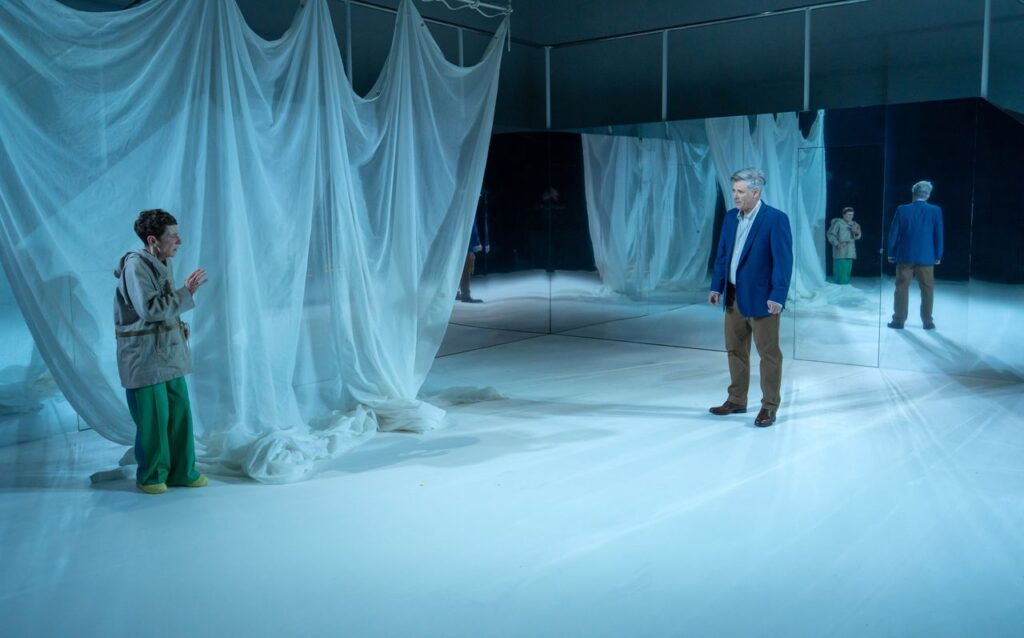
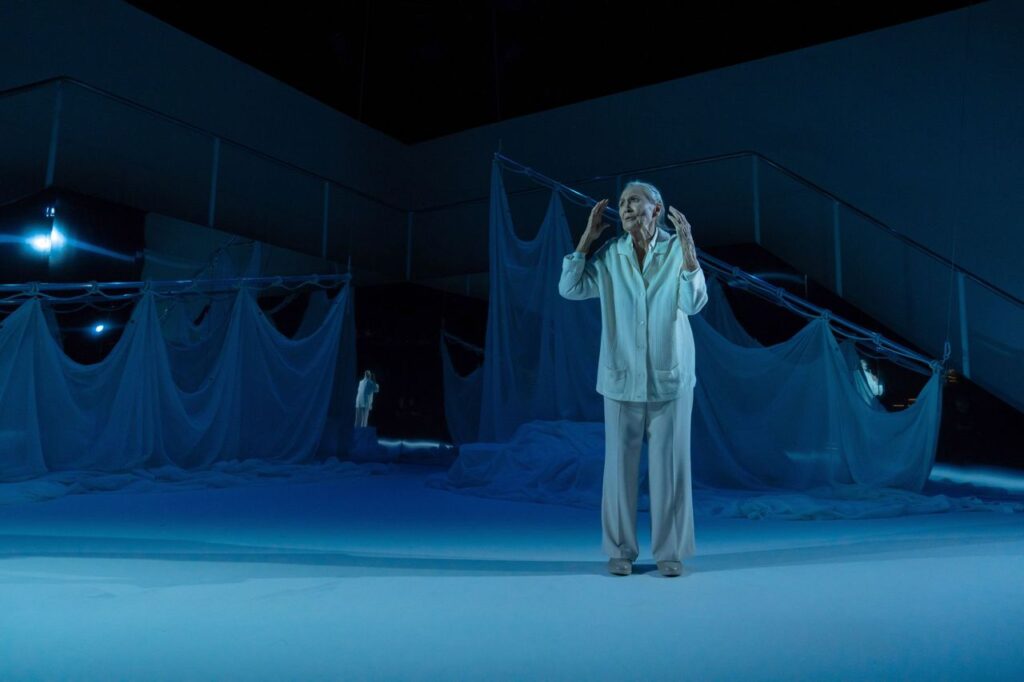
The set design for this production is very clever and reflective of the constantly evolving nature of the minds of the mighty explorers on stage. A stark white stage is draped with hospital curtains suspended from poles at angular positions in mid-air, evoking the icy terrain of the South Pole. At one moment, these curtains fold into a cave-like shape as the explorers take respite for the night after a day’s adventure. It was fascinating to read designer Simone Romaniuk’s commentary on the set, explaining that the mirrored walls at the edge of the stage reflect the audience back at themselves, creating a “fracture perspective, creating a sense of disorientation about what is real”. These mirrored walls eventually open to reveal doors with room numbers and floral wallpaper inside, bringing the audience back to the reality of the nursing home. Maria, who is not from Australia, continues to roam the halls, exclaiming that this is not her home. Despite living in Australia for decades, her reality remains shaped by the pain of losing her husband many years prior, while still celebrating the time she had with him.
As reflected earlier, this production is in danger of leaning too far into melancholy, with little sense of hope in the lives each character is living out. Whilst this can impact overall engagement, particularly when exposition is either too vague or too explicit in its distrust of the audience’s ability to comprehend a character or situation, it does allow space for reflection. More importantly, it serves as a reminder to continue checking in on those in our lives, young or old, who may be experiencing internal struggles that remain unknown to us.
Do Not Go Gentle explores the devastating impact of dementia and the search for a new sense of home as the world once known begins to fade.
Do Not Go Gentle runs until 30 August at Queensland Theatre Company’s Bille Brown Theatre.