
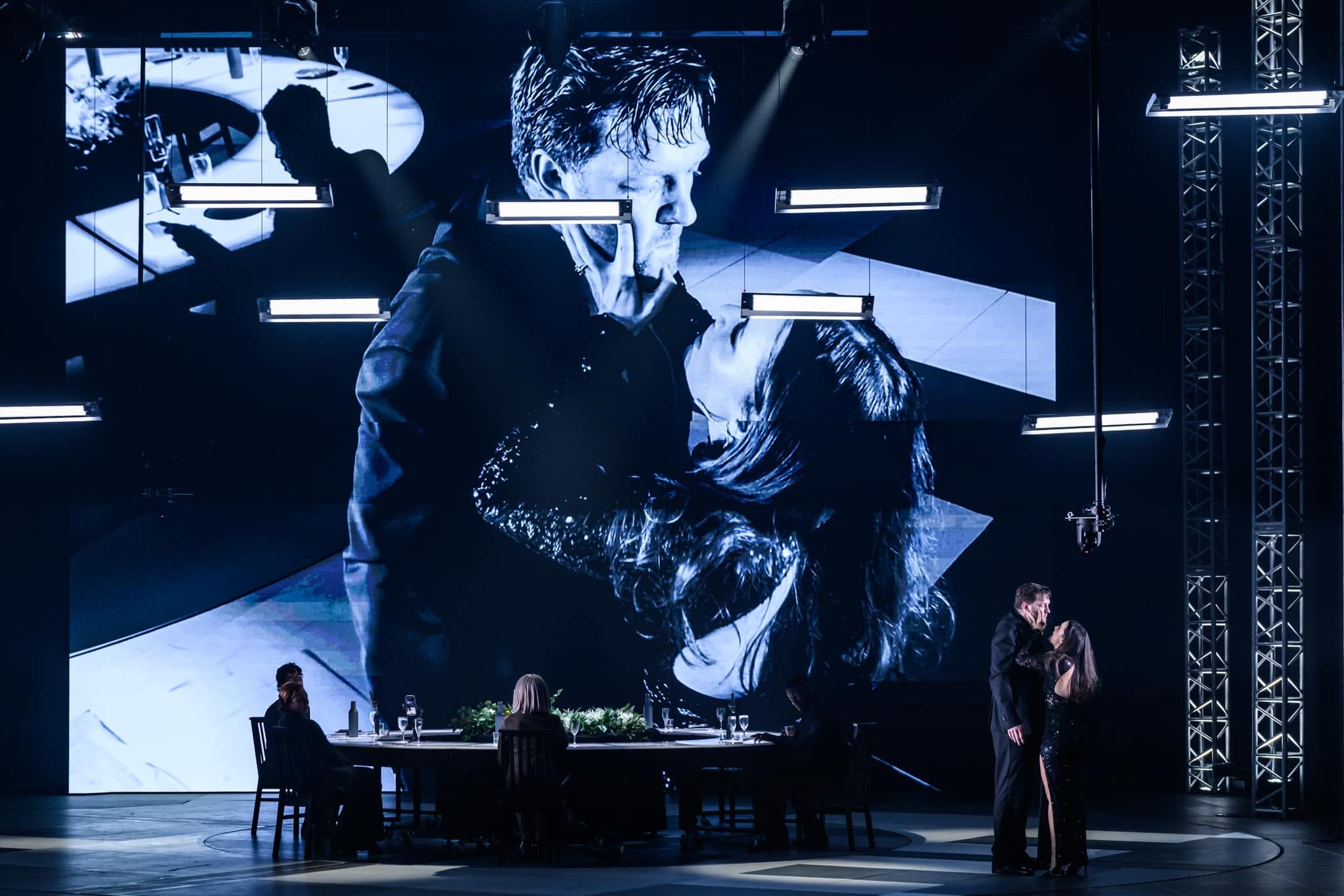
Jeremiah Wray as Macbeth, Nelle Lee as Lady Macbeth and Ensemble in Macbeth. Image credit: Joel Devereux

When shall we three meet again? In QPAC’s Playhouse at the play that must not be named!
It’s official, Shakespeare is SO back! Shake & Stir Theatre Co has returned with one of their most ambitious projects yet, proving that after 20 years in the business the bard’s work is still as relevant as ever. In a world shaped by greed, power, and destruction, art of this calibre plays a crucial role in engaging new generations who seek artistic forms that meaningfully address contemporary social and political issues. It’s a symbolic feast for the soul, and we’re being fed!
William Shakespeare’s blood-soaked tragedy Macbeth is a story that has endured for centuries, yet it is rarely told well. By placing greater emphasis on dramatic expression than audience comprehension, many stage adaptations fail to consider how a character’s language and complexity are interpreted by those watching. However, Macbeth directed by Nick Skubij remains faithful to the source material (we love to see it!), while drawing clear parallels to the political atrocities that flood our news and social media feeds everyday.
This production is layered with symbolism. One notable sequence is the grand banquet following the murder of Macbeth’s friend Banquo. The banquet table is arranged centre stage in the round, with a hollow core filled by a floral centrepiece. Above, livestream footage is projected onto the back of the stage, creating an image that closely resembles a human eye, suggesting that Banquo’s presence, or gaze, continues to haunt Macbeth even beyond the grave.
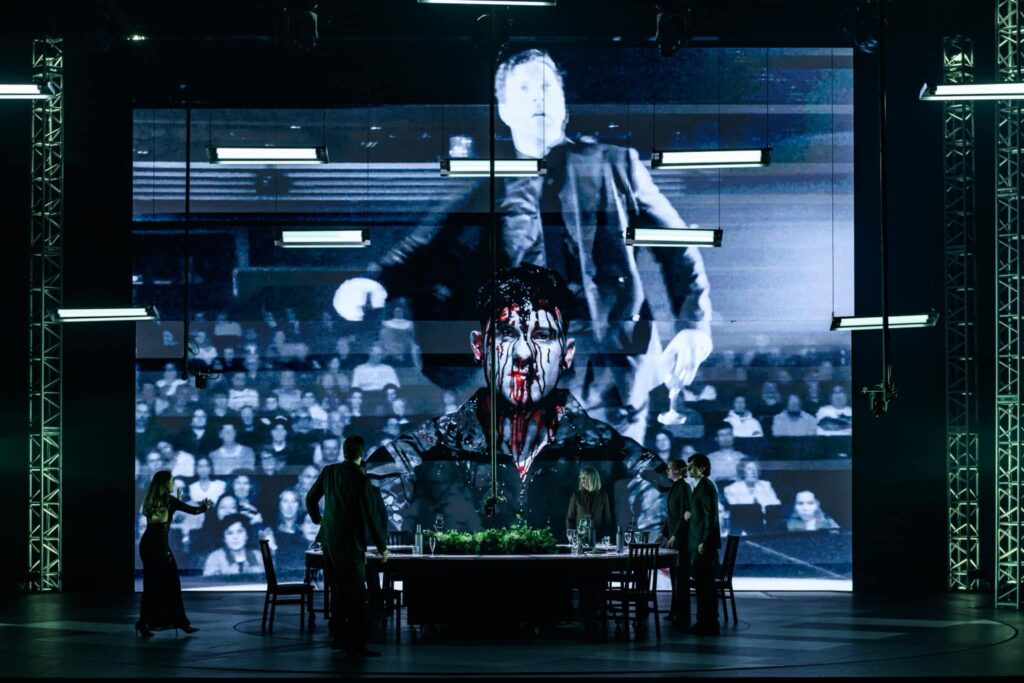
Another standout symbolic image comes in the aftermath of King Duncan’s death. With King Duncan’s face projected across the stage screens, the central projection screen splits at his neck before revealing Macbeth and Lady Macbeth preparing to claim the crown. The visual connection between King Duncan’s murder and the couple’s ascension to power is impossible to miss, powerfully illustrating that their success rests upon an act of violence. It is a moment of staging that is both shocking and thematically resonant.
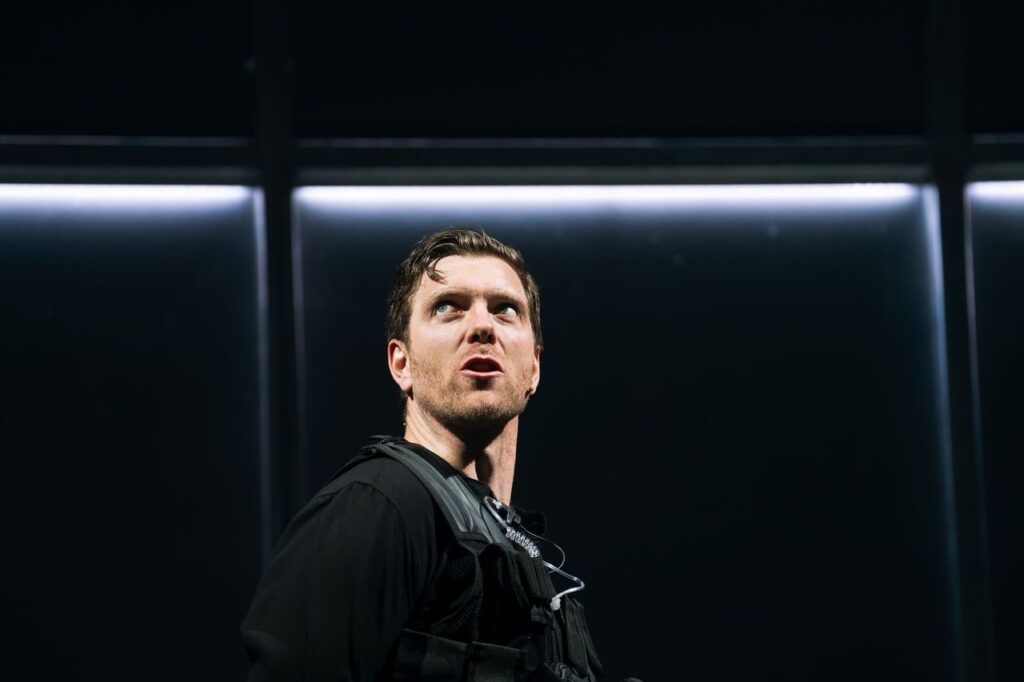
The performances in this production are outstanding, with Jeremiah Wray delivering a particularly commanding portrayal of Macbeth. Of the previous adaptations I’ve seen of the Scottish play, I’ve never feared the antihero until now. Throughout his performance, Wray moves convincingly from regret following the first murder to a chilling emotional detachment as he targets Macduff’s family in the second act. The Macduff family murder was one of the most chilling sequences I’ve seen in theatre, in fact it wouldn’t be out of place in a thriller movie. Wray’s villainous whistle as he searches for Macduff’s son in the darkness is terrifying – you could hear a pin drop the theatre was so still. Wray was truly made for this role and his ability to portray the gradual undoing of Macbeth throughout the course of this show is mesmerising.
Pacharo Mzembe also delivered a powerful performance as Macduff, drawing the audience into his profound grief following the discovery of his family’s murder in the second act. The production’s portrayal of the Weird Sisters was refreshingly simple, relying on little more than cloaks and hoods to transform the actors. At times, their voices even took on a Gollum-like expression, adding an unsettling edge to their presence. This understated approach proved just as effective as elaborate makeup or special effects would have been, demonstrating that atmosphere and performance can be far more powerful than spectacle.
There is often a misconception that Shakespeare’s tragedies are all doom and gloom. While there is some truth to this, humour can often be found in even the darkest of moments. It is pleasing to see that this production does not shy away from comedy amid the tragic unravelling of its principal characters, often leaving audiences uncertain as to whether it is even appropriate to laugh. The beauty of this approach is that the decision ultimately rests with the audience, ensuring that reactions will vary each performance. What a treat for the actors onstage! One standout comedic moment features Macbeth’s messenger, played by Johnny Balbuziente, who, dressed in a baggy suit and tie, rushes on and off stage hastily without uttering a word after being brushed aside by his master. The physical comedy, combined with a “less is more” storytelling approach, works effectively here.
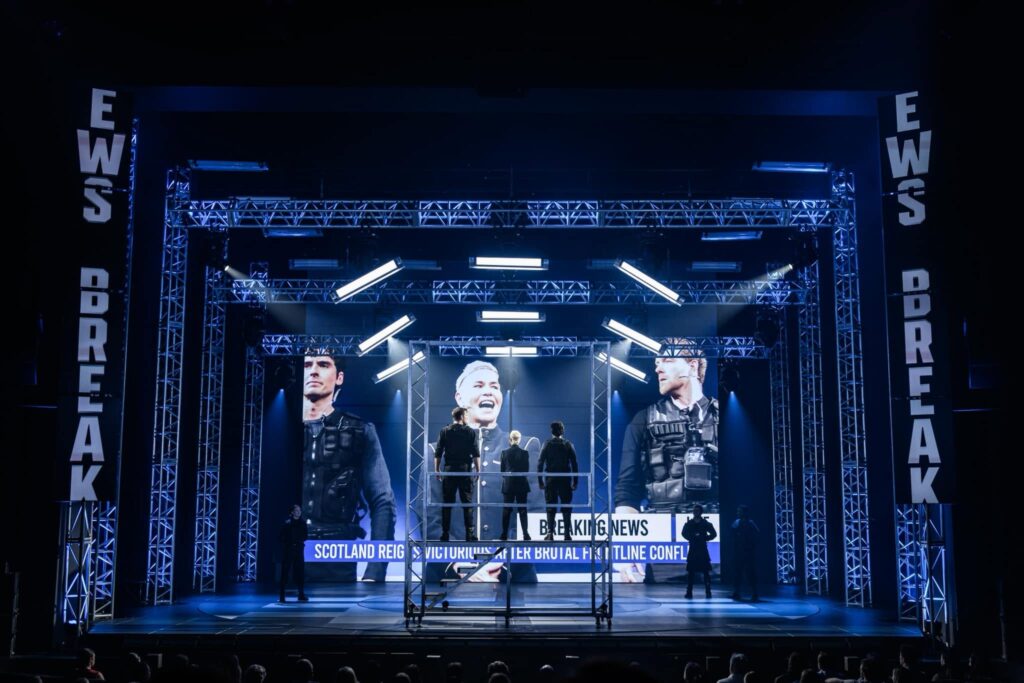
From a design perspective, this show is visually stunning. Shake & Stir is no stranger to a digital screen projection, and here it is used to remarkable effect, visually articulating the inner worlds of the characters and reinforcing the production’s dramatic intent. The use of a live camera feed projected onstage feels very much in keeping with contemporary theatre, a technique popularised in recent years by Tony Award-winning British director Jamie Lloyd through productions such as Sunset Boulevard, Romeo and Juliet and Evita. Having seen Lloyd’s Romeo and Juliet starring Tom Holland in 2024, I was particularly interested in how Shake & Stir would approach the technique. Unlike Lloyd’s production, where livestreaming often felt like a bid for artistic edge rather than a meaningful storytelling tool, Shake & Stir’s Macbeth employs it with clear purpose. Every projection deepens the audience’s understanding of the characters, providing valuable insight into their motivations, choices, and psychological states.
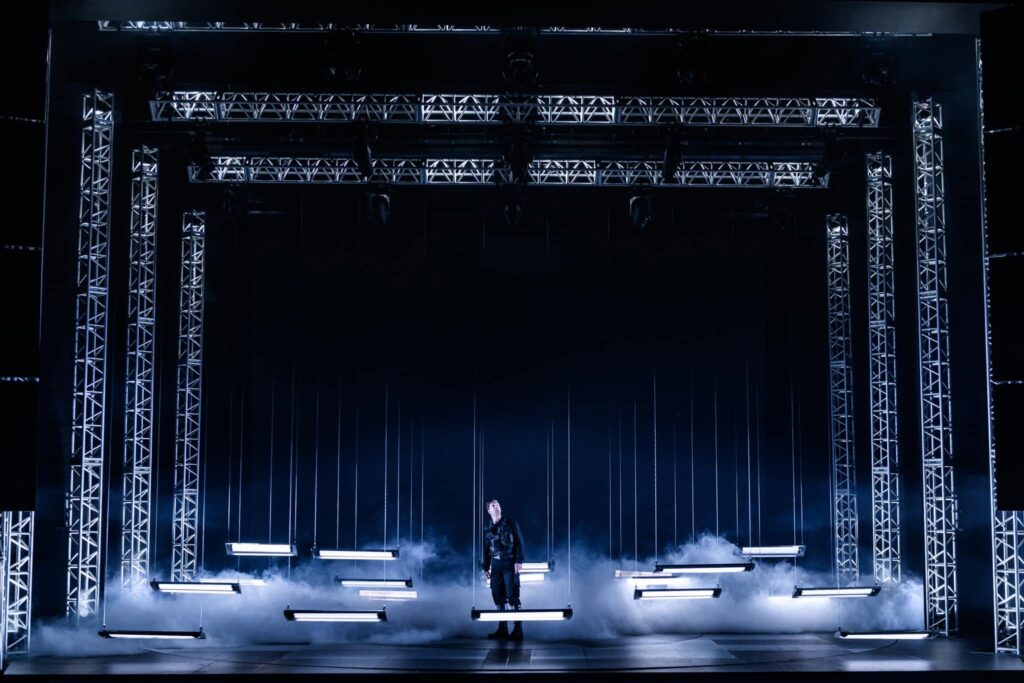
One of the most impressive aspects of the production was its innovative use of lighting, designed by Jason Glenwright. I never knew lights could be used in such a dynamic way – one moment they appeared as clouds floating across the stage, and the next they swayed from side to side, mirroring Macbeth’s increasingly unstable state of mind. As the Weird Sisters chanted their prophecy in the second act, the lighting intensified the sense of foreboding and vividly captured Macbeth’s descent into madness.
This production is truly spectacular and deserves immense praise for crafting a modern adaptation that remains fundamentally Shakespearean. Are they Australians playing Scotsmen in army uniforms with a strong social media presence? Absolutely. It’s a far cry from the kind of production audiences might have encountered at the Globe, yet the production’s close adherence to Shakespeare’s original text leaves little room to question its relevance in a contemporary setting. Instead, it demonstrates just how timeless the play’s themes of ambition, power, and corruption truly are.
Shake and Stir Theatre Co’s Macbeth closes at QPAC’s Playhouse Theatre on Sunday 21 June.
Don’t miss out! Book now at qpac.com.au